
Dependency Inversion Principle - Building Flexible, Testable Architectures
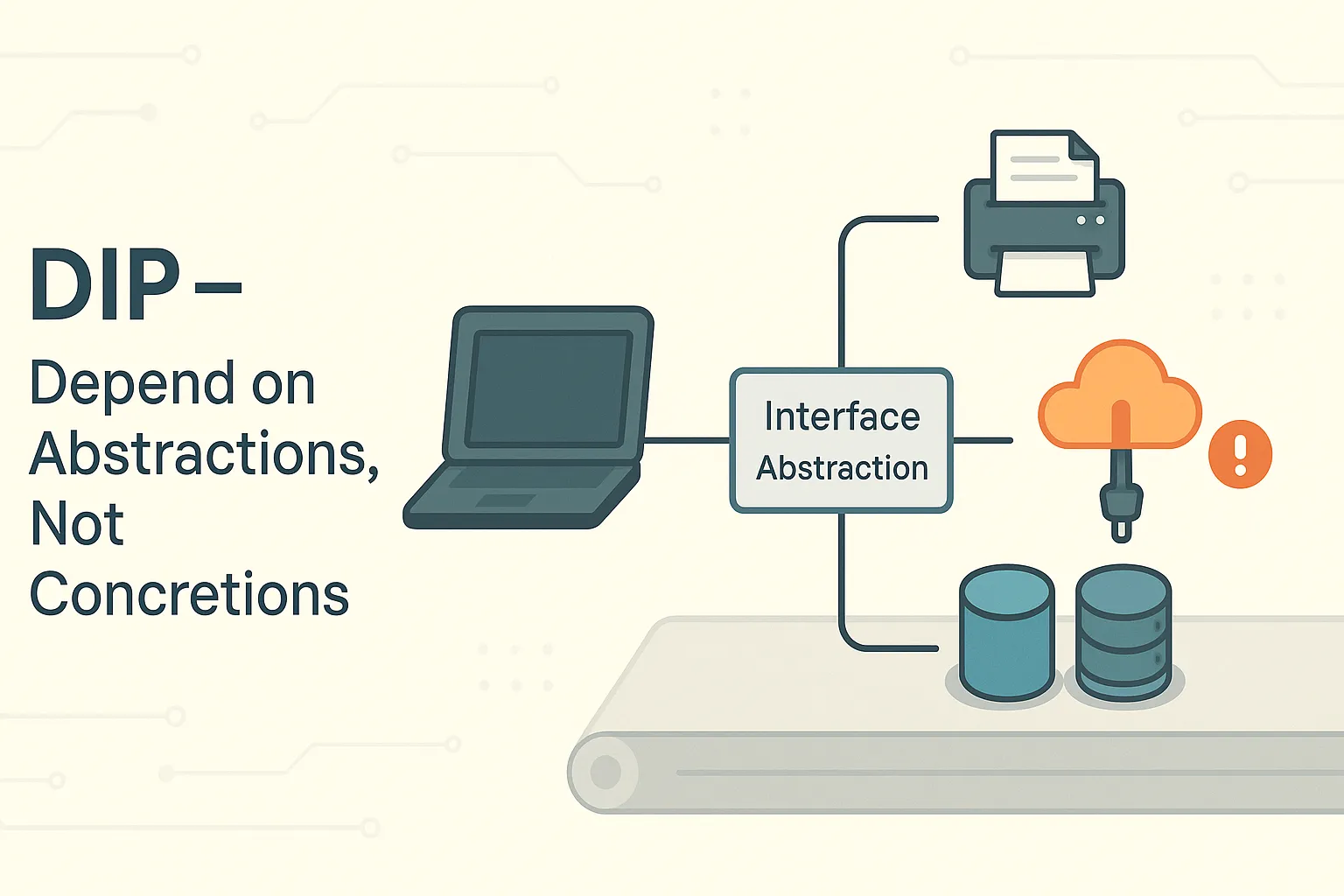
🔄 Understanding the Dependency Inversion Principle
The Dependency Inversion Principle (DIP) is the fifth and final principle in the SOLID design principles, introduced by Robert C. Martin. It states that high-level modules should not depend on low-level modules. Both should depend on abstractions. Additionally, abstractions should not depend on details. Details should depend on abstractions.
This principle is often implemented through Dependency Injection (DI), which is a technique for achieving Inversion of Control (IoC). By inverting dependencies, you create flexible, testable, and maintainable code that can easily adapt to changing requirements.
When DIP is violated, the consequences can be significant:
- Tight Coupling: High-level modules become tightly coupled to low-level implementation details, making changes difficult and risky.
- Testing Difficulties: Direct dependencies on concrete classes make unit testing challenging, as you cannot easily mock or substitute dependencies.
- Reduced Flexibility: Changes to low-level modules can cascade through the entire system, requiring modifications to multiple high-level modules.
- Poor Reusability: High-level modules become tied to specific implementations, reducing their reusability across different contexts.
- Configuration Rigidity: Runtime behavior becomes fixed at compile time, preventing dynamic configuration and plugin architectures.
- Deployment Complexity: Different environments require code changes rather than configuration changes, increasing deployment complexity.
By adhering to DIP, you create systems that are loosely coupled, easily testable, and highly configurable, allowing your software to adapt gracefully to changing requirements.
💻 Examples of DIP in Action
Let's explore how DIP can be applied in real-world scenarios using multiple programming languages. These examples demonstrate common violations and how to refactor them using dependency injection and inversion of control.
Basic Example: Email Service
// ❌ Violates DIP - High-level module depends on low-level concrete class
                      public class OrderService {
                          private readonly SmtpEmailService emailService;

                          public OrderService() {
                              emailService = new SmtpEmailService(); // Direct dependency
                          }

                          public void ProcessOrder(Order order) {
                              // Process order logic
                              emailService.SendEmail(order.CustomerEmail, "Order Confirmation", "Your order has been processed.");
                          }
                      }

                      public class SmtpEmailService {
                          public void SendEmail(string to, string subject, string body) {
                              // SMTP implementation
                              Console.WriteLine($"Sending SMTP email to {to}");
                          }
                      }

                      // ✅ Follows DIP - Depends on abstraction
                      public interface IEmailService {
                          void SendEmail(string to, string subject, string body);
                      }

                      public class OrderService {
                          private readonly IEmailService emailService;

                          public OrderService(IEmailService emailService) {
                              this.emailService = emailService; // Dependency injected
                          }

                          public void ProcessOrder(Order order) {
                              // Process order logic
                              emailService.SendEmail(order.CustomerEmail, "Order Confirmation", "Your order has been processed.");
                          }
                      }

                      public class SmtpEmailService : IEmailService {
                          public void SendEmail(string to, string subject, string body) {
                              Console.WriteLine($"Sending SMTP email to {to}");
                          }
                      }

                      public class SendGridEmailService : IEmailService {
                          public void SendEmail(string to, string subject, string body) {
                              Console.WriteLine($"Sending SendGrid email to {to}");
                          }
                      }
Python Example: Database Access
# ❌ Violates DIP - Direct dependency on MySQL implementation
                      import mysql.connector

                      class UserService:
                          def __init__(self):
                              self.connection = mysql.connector.connect(
                                  host='localhost',
                                  database='myapp',
                                  user='root',
                                  password='password'
                              )

                          def get_user(self, user_id):
                              cursor = self.connection.cursor()
                              cursor.execute("SELECT * FROM users WHERE id = %s", (user_id,))
                              return cursor.fetchone()

                      # ✅ Follows DIP - Depends on abstraction
                      from abc import ABC, abstractmethod

                      class DatabaseRepository(ABC):
                          @abstractmethod
                          def find_by_id(self, table, user_id):
                              pass

                          @abstractmethod
                          def save(self, table, data):
                              pass

                      class UserService:
                          def __init__(self, repository: DatabaseRepository):
                              self.repository = repository

                          def get_user(self, user_id):
                              return self.repository.find_by_id('users', user_id)

                          def save_user(self, user_data):
                              return self.repository.save('users', user_data)

                      class MySQLRepository(DatabaseRepository):
                          def __init__(self, connection_string):
                              self.connection = mysql.connector.connect(connection_string)

                          def find_by_id(self, table, user_id):
                              cursor = self.connection.cursor()
                              cursor.execute(f"SELECT * FROM {table} WHERE id = %s", (user_id,))
                              return cursor.fetchone()

                          def save(self, table, data):
                              # MySQL-specific save implementation
                              pass

                      class MongoRepository(DatabaseRepository):
                          def __init__(self, connection_string):
                              from pymongo import MongoClient
                              self.client = MongoClient(connection_string)
                              self.db = self.client.myapp

                          def find_by_id(self, table, user_id):
                              collection = self.db[table]
                              return collection.find_one({'_id': user_id})

                          def save(self, table, data):
                              # MongoDB-specific save implementation
                              collection = self.db[table]
                              return collection.insert_one(data)
JavaScript Example: API Client
// ❌ Violates DIP - Hardcoded to fetch API
                      class WeatherService {
                          constructor() {
                              this.apiUrl = 'https://api.openweathermap.org';
                          }

                          async getWeather(city) {
                              const response = await fetch(`${this.apiUrl}/weather?q=${city}`);
                              return response.json();
                          }
                      }

                      // ✅ Follows DIP - Depends on abstraction
                      class WeatherService {
                          constructor(httpClient) {
                              this.httpClient = httpClient;
                          }

                          async getWeather(city) {
                              return await this.httpClient.get(`/weather?q=${city}`);
                          }
                      }

                      class FetchHttpClient {
                          constructor(baseUrl) {
                              this.baseUrl = baseUrl;
                          }

                          async get(endpoint) {
                              const response = await fetch(`${this.baseUrl}${endpoint}`);
                              return response.json();
                          }

                          async post(endpoint, data) {
                              const response = await fetch(`${this.baseUrl}${endpoint}`, {
                                  method: 'POST',
                                  headers: { 'Content-Type': 'application/json' },
                                  body: JSON.stringify(data)
                              });
                              return response.json();
                          }
                      }

                      class AxiosHttpClient {
                          constructor(baseUrl) {
                              this.axios = require('axios').create({ baseURL: baseUrl });
                          }

                          async get(endpoint) {
                              const response = await this.axios.get(endpoint);
                              return response.data;
                          }

                          async post(endpoint, data) {
                              const response = await this.axios.post(endpoint, data);
                              return response.data;
                          }
                      }

                      // Usage with different implementations
                      const fetchClient = new FetchHttpClient('https://api.openweathermap.org');
                      const axiosClient = new AxiosHttpClient('https://api.openweathermap.org');

                      const weatherServiceWithFetch = new WeatherService(fetchClient);
                      const weatherServiceWithAxios = new WeatherService(axiosClient);
🌍 Real-World DIP Examples
Let's examine more complex, real-world scenarios where DIP provides significant benefits in enterprise applications.
Enterprise E-Commerce System
// ❌ Violates DIP - Tightly coupled to specific implementations
                      public class OrderProcessor {
                          private readonly SqlServerRepository repository;
                          private readonly StripePaymentGateway paymentGateway;
                          private readonly SmtpEmailService emailService;
                          private readonly FileLogger logger;

                          public OrderProcessor() {
                              repository = new SqlServerRepository();
                              paymentGateway = new StripePaymentGateway();
                              emailService = new SmtpEmailService();
                              logger = new FileLogger();
                          }

                          public async Task ProcessOrderAsync(Order order) {
                              logger.Log("Processing order: " + order.Id);

                              var payment = await paymentGateway.ProcessPaymentAsync(order.Amount);
                              if (payment.IsSuccessful) {
                                  await repository.SaveOrderAsync(order);
                                  await emailService.SendConfirmationAsync(order.CustomerEmail);
                              }
                          }
                      }

                      // ✅ Follows DIP - Depends on abstractions with proper DI
                      public interface IRepository {
                          Task SaveOrderAsync(Order order);
                          Task GetOrderAsync(int orderId);
                      }

                      public interface IPaymentGateway {
                          Task ProcessPaymentAsync(decimal amount);
                      }

                      public interface IEmailService {
                          Task SendConfirmationAsync(string email);
                      }

                      public interface ILogger {
                          void Log(string message);
                          void LogError(string message, Exception ex);
                      }

                      public class OrderProcessor {
                          private readonly IRepository repository;
                          private readonly IPaymentGateway paymentGateway;
                          private readonly IEmailService emailService;
                          private readonly ILogger logger;

                          public OrderProcessor(
                              IRepository repository,
                              IPaymentGateway paymentGateway,
                              IEmailService emailService,
                              ILogger logger) {
                              this.repository = repository;
                              this.paymentGateway = paymentGateway;
                              this.emailService = emailService;
                              this.logger = logger;
                          }

                          public async Task ProcessOrderAsync(Order order) {
                              logger.Log($"Processing order: {order.Id}");

                              try {
                                  var payment = await paymentGateway.ProcessPaymentAsync(order.Amount);
                                  if (payment.IsSuccessful) {
                                      await repository.SaveOrderAsync(order);
                                      await emailService.SendConfirmationAsync(order.CustomerEmail);
                                      logger.Log($"Order {order.Id} processed successfully");
                                  }
                              }
                              catch (Exception ex) {
                                  logger.LogError($"Failed to process order {order.Id}", ex);
                                  throw;
                              }
                          }
                      }

                      // Multiple implementations
                      public class SqlServerRepository : IRepository {
                          public async Task SaveOrderAsync(Order order) { /* SQL Server implementation */ }
                          public async Task GetOrderAsync(int orderId) { /* SQL Server implementation */ }
                      }

                      public class CosmosDbRepository : IRepository {
                          public async Task SaveOrderAsync(Order order) { /* Cosmos DB implementation */ }
                          public async Task GetOrderAsync(int orderId) { /* Cosmos DB implementation */ }
                      }

                      public class StripePaymentGateway : IPaymentGateway {
                          public async Task ProcessPaymentAsync(decimal amount) { /* Stripe implementation */ }
                      }

                      public class PayPalPaymentGateway : IPaymentGateway {
                          public async Task ProcessPaymentAsync(decimal amount) { /* PayPal implementation */ }
                      }
Microservices Communication
# ✅ DIP-compliant microservices architecture
                      from abc import ABC, abstractmethod
                      from typing import Dict, Any
                      import json

                      class MessageBroker(ABC):
                          @abstractmethod
                          async def publish(self, topic: str, message: Dict[str, Any]) -> None:
                              pass

                          @abstractmethod
                          async def subscribe(self, topic: str, handler) -> None:
                              pass

                      class ConfigurationProvider(ABC):
                          @abstractmethod
                          def get_setting(self, key: str) -> str:
                              pass

                      class HealthChecker(ABC):
                          @abstractmethod
                          async def check_health(self, service_name: str) -> bool:
                              pass

                      class UserService:
                          def __init__(self,
                                       message_broker: MessageBroker,
                                       config_provider: ConfigurationProvider,
                                       health_checker: HealthChecker):
                              self.message_broker = message_broker
                              self.config_provider = config_provider
                              self.health_checker = health_checker

                          async def create_user(self, user_data: Dict[str, Any]) -> Dict[str, Any]:
                              # Create user logic
                              user = {'id': 123, 'name': user_data['name'], 'email': user_data['email']}

                              # Publish user created event
                              await self.message_broker.publish('user.created', {
                                  'user_id': user['id'],
                                  'email': user['email'],
                                  'timestamp': '2025-08-10T12:00:00Z'
                              })

                              return user

                          async def get_user_profile(self, user_id: int) -> Dict[str, Any]:
                              # Check if profile service is healthy
                              profile_service_url = self.config_provider.get_setting('profile_service_url')
                              is_healthy = await self.health_checker.check_health('profile-service')

                              if not is_healthy:
                                  return {'error': 'Profile service unavailable'}

                              # Get user profile from profile service
                              return {'user_id': user_id, 'profile': 'user profile data'}

                      # Implementation classes
                      class RabbitMQMessageBroker(MessageBroker):
                          async def publish(self, topic: str, message: Dict[str, Any]) -> None:
                              print(f"Publishing to RabbitMQ topic {topic}: {json.dumps(message)}")

                          async def subscribe(self, topic: str, handler) -> None:
                              print(f"Subscribing to RabbitMQ topic {topic}")

                      class KafkaMessageBroker(MessageBroker):
                          async def publish(self, topic: str, message: Dict[str, Any]) -> None:
                              print(f"Publishing to Kafka topic {topic}: {json.dumps(message)}")

                          async def subscribe(self, topic: str, handler) -> None:
                              print(f"Subscribing to Kafka topic {topic}")

                      class EnvironmentConfigProvider(ConfigurationProvider):
                          def get_setting(self, key: str) -> str:
                              import os
                              return os.getenv(key, '')

                      class ConsulConfigProvider(ConfigurationProvider):
                          def get_setting(self, key: str) -> str:
                              # Consul implementation
                              return f"consul_value_for_{key}"

                      class HttpHealthChecker(HealthChecker):
                          async def check_health(self, service_name: str) -> bool:
                              # HTTP health check implementation
                              return True
🎯 DIP Implementation Guidelines
Here are practical guidelines and patterns for implementing the Dependency Inversion Principle effectively in your applications.
1. Dependency Injection Container Pattern
// ✅ Using built-in DI container in .NET
                      public class Startup {
                          public void ConfigureServices(IServiceCollection services) {
                              // Register dependencies
                              services.AddScoped<IRepository, SqlServerRepository>();
                              services.AddScoped<IEmailService, SendGridEmailService>();
                              services.AddScoped<IPaymentGateway, StripePaymentGateway>();
                              services.AddSingleton<ILogger, ApplicationLogger>();

                              // Register high-level services
                              services.AddScoped<OrderProcessor>();
                              services.AddScoped<UserService>();
                          }
                      }

                      // ✅ Constructor injection with multiple dependencies
                      public class OrderController : ControllerBase {
                          private readonly OrderProcessor orderProcessor;
                          private readonly ILogger logger;

                          public OrderController(OrderProcessor orderProcessor, ILogger logger) {
                              this.orderProcessor = orderProcessor;
                              this.logger = logger;
                          }

                          [HttpPost]
                          public async Task<IActionResult> CreateOrder([FromBody] CreateOrderRequest request) {
                              try {
                                  var order = new Order { /* map from request */ };
                                  await orderProcessor.ProcessOrderAsync(order);
                                  return Ok();
                              }
                              catch (Exception ex) {
                                  logger.LogError("Order creation failed", ex);
                                  return StatusCode(500);
                              }
                          }
                      }
2. Factory Pattern with DIP
// ✅ Abstract factory for creating related dependencies
                      public interface IServiceFactory {
                          IPaymentGateway CreatePaymentGateway(string provider);
                          IEmailService CreateEmailService(string provider);
                      }

                      public class ServiceFactory : IServiceFactory {
                          private readonly IServiceProvider serviceProvider;

                          public ServiceFactory(IServiceProvider serviceProvider) {
                              this.serviceProvider = serviceProvider;
                          }

                          public IPaymentGateway CreatePaymentGateway(string provider) {
                              return provider.ToLower() switch {
                                  "stripe" => serviceProvider.GetService<StripePaymentGateway>(),
                                  "paypal" => serviceProvider.GetService<PayPalPaymentGateway>(),
                                  _ => throw new ArgumentException($"Unknown payment provider: {provider}")
                              };
                          }

                          public IEmailService CreateEmailService(string provider) {
                              return provider.ToLower() switch {
                                  "smtp" => serviceProvider.GetService<SmtpEmailService>(),
                                  "sendgrid" => serviceProvider.GetService<SendGridEmailService>(),
                                  _ => throw new ArgumentException($"Unknown email provider: {provider}")
                              };
                          }
                      }
3. Configuration-Driven Dependency Selection
// ✅ Configuration-based dependency injection in Node.js
                      class DependencyContainer {
                          constructor(config) {
                              this.config = config;
                              this.dependencies = new Map();
                              this.registerDependencies();
                          }

                          registerDependencies() {
                              // Register database based on configuration
                              if (this.config.database.type === 'mongodb') {
                                  this.dependencies.set('repository', new MongoRepository(this.config.database.connectionString));
                              } else if (this.config.database.type === 'postgresql') {
                                  this.dependencies.set('repository', new PostgreSQLRepository(this.config.database.connectionString));
                              }

                              // Register payment gateway based on configuration
                              if (this.config.payment.provider === 'stripe') {
                                  this.dependencies.set('paymentGateway', new StripePaymentGateway(this.config.payment.apiKey));
                              } else if (this.config.payment.provider === 'paypal') {
                                  this.dependencies.set('paymentGateway', new PayPalPaymentGateway(this.config.payment.credentials));
                              }

                              // Register logger based on environment
                              if (this.config.environment === 'production') {
                                  this.dependencies.set('logger', new CloudLogger(this.config.logging.cloudConfig));
                              } else {
                                  this.dependencies.set('logger', new ConsoleLogger());
                              }
                          }

                          get(dependencyName) {
                              if (!this.dependencies.has(dependencyName)) {
                                  throw new Error(`Dependency '${dependencyName}' not registered`);
                              }
                              return this.dependencies.get(dependencyName);
                          }

                          createOrderService() {
                              return new OrderService(
                                  this.get('repository'),
                                  this.get('paymentGateway'),
                                  this.get('logger')
                              );
                          }
                      }

                      // Usage
                      const config = {
                          database: { type: 'mongodb', connectionString: 'mongodb://localhost:27017/myapp' },
                          payment: { provider: 'stripe', apiKey: 'sk_test_...' },
                          environment: 'development',
                          logging: { level: 'debug' }
                      };

                      const container = new DependencyContainer(config);
                      const orderService = container.createOrderService();
4. Testing with DIP
# ✅ Easy unit testing with dependency injection
                      import unittest
                      from unittest.mock import Mock, AsyncMock
                      import pytest

                      class TestOrderProcessor(unittest.TestCase):
                          def setUp(self):
                              # Create mocks for all dependencies
                              self.mock_repository = Mock()
                              self.mock_payment_gateway = Mock()
                              self.mock_email_service = Mock()
                              self.mock_logger = Mock()

                              # Create the service under test with mocked dependencies
                              self.order_processor = OrderProcessor(
                                  repository=self.mock_repository,
                                  payment_gateway=self.mock_payment_gateway,
                                  email_service=self.mock_email_service,
                                  logger=self.mock_logger
                              )

                          async def test_successful_order_processing(self):
                              # Arrange
                              order = Order(id=1, amount=100.0, customer_email="test@example.com")
                              payment_result = PaymentResult(is_successful=True, transaction_id="txn_123")

                              self.mock_payment_gateway.process_payment_async.return_value = payment_result
                              self.mock_repository.save_order_async.return_value = None
                              self.mock_email_service.send_confirmation_async.return_value = None

                              # Act
                              await self.order_processor.process_order_async(order)

                              # Assert
                              self.mock_payment_gateway.process_payment_async.assert_called_once_with(100.0)
                              self.mock_repository.save_order_async.assert_called_once_with(order)
                              self.mock_email_service.send_confirmation_async.assert_called_once_with("test@example.com")
                              self.mock_logger.log.assert_called()

                          async def test_failed_payment_processing(self):
                              # Arrange
                              order = Order(id=1, amount=100.0, customer_email="test@example.com")
                              payment_result = PaymentResult(is_successful=False, error_message="Insufficient funds")

                              self.mock_payment_gateway.process_payment_async.return_value = payment_result

                              # Act
                              await self.order_processor.process_order_async(order)

                              # Assert
                              self.mock_payment_gateway.process_payment_async.assert_called_once_with(100.0)
                              self.mock_repository.save_order_async.assert_not_called()
                              self.mock_email_service.send_confirmation_async.assert_not_called()
5. DIP Best Practices
- Define Clear Abstractions: Create interfaces that represent business capabilities rather than implementation details.
- Use Constructor Injection: Prefer constructor injection over property or method injection for required dependencies.
- Avoid Service Locator: Don't use the service locator pattern as it creates hidden dependencies and makes testing difficult.
- Keep Interfaces Focused: Follow the Interface Segregation Principle when designing abstractions for DIP.
- Use Composition Root: Configure all dependencies in a single location (composition root) at the application's entry point.
- Avoid Circular Dependencies: Design your dependency graph to be acyclic and hierarchical.
- Consider Lifetime Management: Choose appropriate lifetimes (singleton, scoped, transient) for your dependencies.
- Use Factory Pattern for Complex Creation: When object creation involves complex logic, use factories that are also injected as dependencies.
Comments
Loading comments…