
Foundations: What Exactly Is Generative AI?
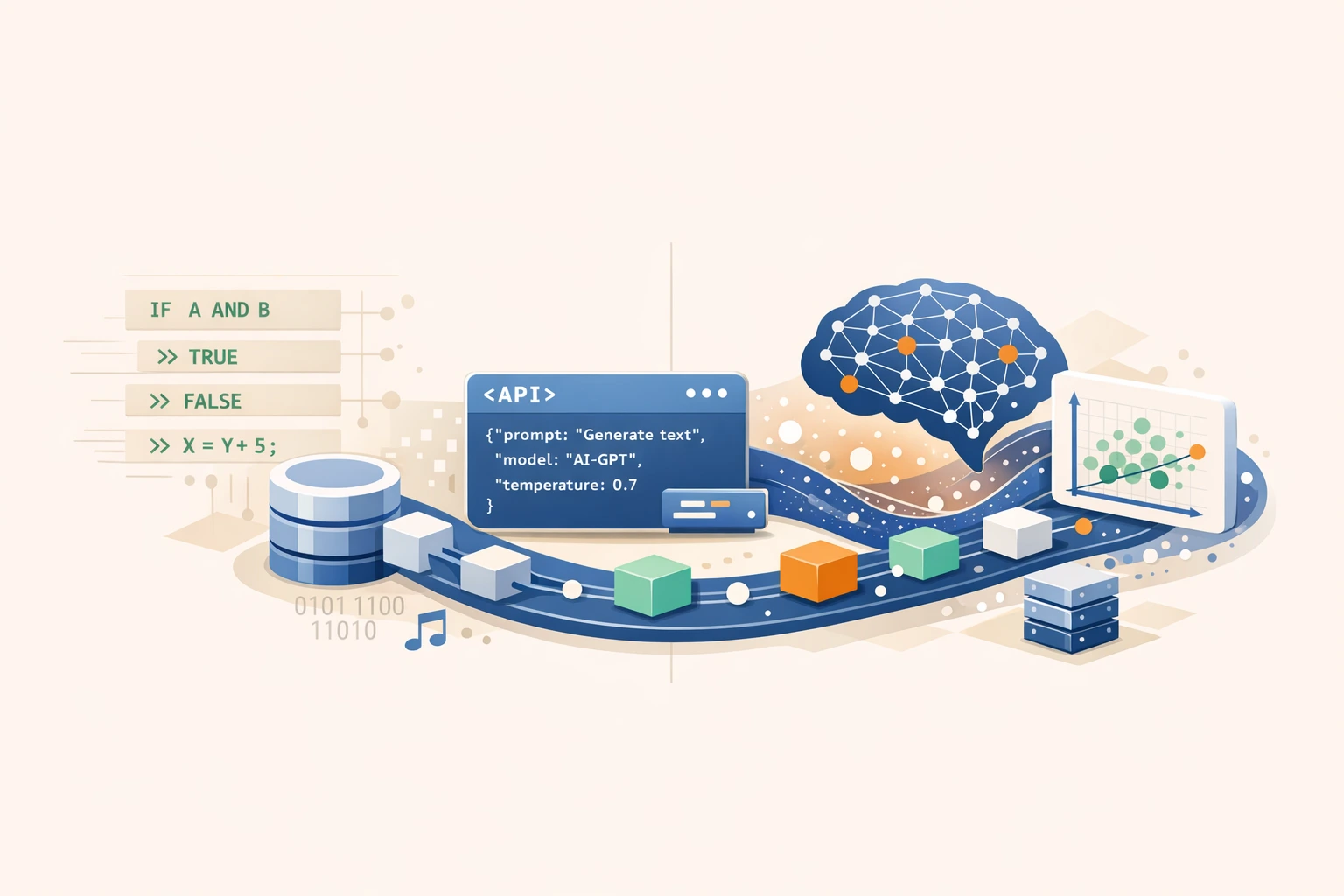
What Exactly Is Generative AI? From If-Else to the Probabilistic Wild West
Introduction
“You are used to Input A equaling Output B. Welcome to the probabilistic wild west.”
Picture this: your team adds a “smart” summarization feature to an otherwise boring, deterministic microservice. Yesterday, your JSON tests were green. Today, the same request returns a perfectly reasonable—but differently worded—summary. No code or infra changed. Your pager goes off because downstream JSON parsing failed on a field that was just… spelled differently.
What happened? You left the highway of fixed rules and entered a city of probabilities. Generative AI doesn’t “compute” the one right answer—it samples a plausible next answer from a learned distribution of language. That unlocks power (creativity, adaptability) and introduces ambiguity (nondeterminism, drift). This post is the whiteboard walkthrough I give teams when we wire GenAI into production systems: what it is, how the math actually flows, why it changes testing and debugging, and how to build with it like an engineer—not a gambler.
Breaking Down the Core Concept
Generative AI is the shift from deterministic logic to probabilistic reasoning frameworks.
- Deterministic logic: Given the same inputs, the same branch conditions fire, the same function paths run, the same output emerges. Great for billing systems and cryptography. The system is a function f(x) = y.
- Generative AI: The model estimates a probability distribution over possible next tokens (words/subwords). It then samples from that distribution to produce text, code, or images. Given the same inputs, it can produce varied yet valid outputs. The system is a distribution P(y | x).
Under the hood, modern language models learn a high-dimensional probability field over token sequences. During training, they adjust weights to minimize cross-entropy—the gap between the model’s predicted distribution and the actual distribution of human-written next tokens. Put plainly: they learn “how people typically continue this kind of sentence,” encoded as parameters that shape the probability of every next token.
How It Works: Step-by-Step
Let’s draw this like we’re at the glass board.
- Tokenization
- Your prompt is split into tokens (subword units). Each token is an index into a large vocabulary (e.g., 50k tokens).
- Embedding
- Each token index maps to a high-dimensional vector (e.g., 4096 floats). Now your text lives in a numeric space where semantically similar tokens tend to be nearby.
- Transformer Blocks
- A stack of attention + feed-forward layers mixes context. Self-attention lets each position “look at” other positions to compute context-aware representations.
- Output Projection (Logits)
- The final hidden vector is multiplied by a large matrix W_out to produce a vector of raw scores (logits), one per vocabulary token.
- Softmax with Temperature
- Apply softmax to logits to get probabilities. Temperature T rescales logits; lower T sharpens peaks (more deterministic), higher T flattens (more diverse).
- Sampling
- Draw the next token according to probabilities. Append it. Repeat.
flowchart TD
                          A[User Prompt] --> B[Tokenizer]
                          B --> C[Embedding Layer]
                          C --> D[Transformer Block 1]
                          D --> E[Transformer Block 2]
                          E --> F[... N Blocks ...]
                          F --> G[Linear Projection W_out]
                          G --> H["Logits (|Vocab|)"]
                          H --> I[Softmax + Temperature]
                          I --> J[Sample Next Token]
                          J --> K{Stop?}
                          K -- No --> L[Append Token to Context]
                          L --> D
                          K -- Yes --> M[Return Generated Text]
Under the hood detail:
- High-dimensional token space: Every token is represented by a vector in thousands of dimensions. Attention learns contextual transformations in that space.
- Cross-entropy training: The model compares its predicted probability distribution for the next token to what humans actually wrote, nudging weights to reduce divergence. Over billions of examples, weights converge to a dense mapping of the statistical patterns of human speech and code.
The Whiteboard Analogy
Think of three engines you know:
- A hardcoded calculator: For 2 + 2, you always get 4. Deterministic and exact.
- A REST endpoint with an immutable schema: You send a payload; you get a contract-bound response. Deterministic protocol, maybe dynamic data, but schema is fixed.
- A fuzzy autocomplete: It suggests “intent-aware” completions. It doesn’t enforce one correct answer; it samples from likely continuations given context.
Generative AI is the last one. It’s a probability-driven autocomplete on steroids—aware of massive context, style, and task hints—yet still playing in the uncertainty sandbox.
Architectural Trade-offs & Comparisons
|
Dimension |
Traditional Dev (Deterministic Logic) |
Predictive ML (Deterministic Inference) |
Generative AI (Probabilistic Sampling) |
|---|---|---|---|
|
Output determinism |
Identical inputs produce identical outputs; perfect reproducibility. |
Given a fixed model and features, outputs are repeatable; thresholds make discrete decisions. |
Same prompt can yield different valid outputs; sampling introduces controlled randomness. |
|
Primary artifact |
Code paths, rules, and state machines encode behavior. |
Model predicts labels/scores; downstream logic is deterministic. |
Model emits sequences by sampling tokens from a learned distribution. |
|
Data requirement |
Minimal beyond domain logic and tests. |
Labeled dataset; features engineered; offline training. |
Massive corpora; token-level next-step prediction; emergent style/knowledge. |
|
Failure modes |
Logic bugs, schema mismatches, null refs. |
Concept drift, poor calibration, misclassification. |
Hallucinations, style variance, non-conforming output shapes. |
|
Test strategy |
Exact assertions; unit and contract tests dominate. |
Metric-based validation (AUC, precision/recall) plus unit tests. |
Fuzzy assertions, schema validators, golden-set evaluations, sampling-based QA. |
|
Latency & cost |
Predictable; scales with CPU and I/O. |
Predictable; usually light CPU/GPU. |
Variable; token-by-token generation on GPU; cost ties to prompt+output length. |
|
Control surfaces |
If-else, configs, feature flags. |
Thresholds, calibration, retraining cadence. |
Temperature, top-k/p, system prompts, logit bias, tool-calling, structured decoding. |
|
Interpretability |
Transparent by reading code. |
Moderate; feature importances, SHAP. |
Low; billions of parameters encode distributions implicitly. |
|
Security concerns |
Input validation, RBAC, injection via parameters. |
Data leakage, adversarial examples (niche). |
Prompt injection, data exfiltration via tools, jailbreaks, untrusted content handling. |
|
Versioning |
Semantic versioning of services/APIs. |
Model version pinning; training dataset lineage. |
Strict model pinning + prompt/version pinning + sampling param pinning. |
Why This Matters to Your Stack
- Debuggability shifts from stack traces to distribution traces. You’ll log prompts, seeds, temperatures, and sampling strategies to reproduce behavior.
- Tests evolve from “exact string equals” to “valid under schema + passes semantic checks + within style tolerances.”
- Reliability becomes “control the distribution.” You’ll tighten temperature, add top-k/p, and bias toward allowed tokens for compliance tasks.
- Observability is not just latencies and 500s; it includes model versioning, prompt drift, output conformance rate, and human-in-the-loop feedback loops.
- Idempotency and caching keys must include not just input but also model version and sampling parameters.
Production Implementation & Use Cases
Where this lives in real systems:
- Summarization and redaction pipelines: Deterministic shell (schema validators, PII checks) around a generative core with temperature near 0 for consistency.
- RAG (Retrieval-Augmented Generation): Deterministic retrieval path, probabilistic answer generator. Observability glues both: which docs fed the model and with what params.
- Code assistants and transformations: Higher temperatures for brainstorming; lower for refactoring and lint-fix tasks.
- Conversational automation: Tool-calling gated by allowlists; structured outputs with JSON schema decoding; strict temperature control.
- Domain-specific report generation: Style-guided prompts with few-shot exemplars; output post-processed by validators and diff-checkers against golden patterns.
Developer Impact: Debugging, TDD, and Validation
- Debugging
- Log prompt, system instructions, model version, temperature, top-k/p, and random seed (when supported).
- Store the exact token-level outputs for failed cases to replay and compare probability mass changes.
- TDD
- Replace exact string asserts with:
- Structural validation (JSON schema).
- Semantic checks (does it contain required facts? Are numbers preserved?).
- Similarity thresholds (embedding cosine similarity to a golden answer).
- Write “behavioral envelopes”: examples that define acceptable variety and unacceptable deviations.
- Replace exact string asserts with:
- Validation and Guardrails
- Constrained decoding: request JSON mode or a grammar to make the sampler only emit legal tokens.
- Post-generation validators: regex + schema + unit logic to catch unsafe or malformed outputs.
- N-best or multi-sample with ranking: generate multiple candidates, pick the best by a deterministic scorer.
Python Coding Simulation: The Temperature Dial and Token Probabilities
Here’s a simple “screen-share” to visualize what happens when you turn Temperature from 0 to 1. We’ll start with fixed logits (raw scores) for a tiny toy vocabulary and see how probabilities reshape as T changes.
# pip install numpy
                      import numpy as np

                      # Imagine a tiny vocabulary of 6 tokens with model-produced logits (raw scores)
                      tokens = np.array(["alpha", "beta", "gamma", "delta", "epsilon", "zeta"])
                      logits = np.array([3.2, 2.1, 1.5, 0.1, -0.5, -1.0], dtype=np.float64)

                      def softmax_with_temperature(logits, T):
                          # Avoid division by zero when T=0 by using an epsilon and explaining "argmax" behavior
                          eps = 1e-8
                          scaled = logits / max(T, eps)
                          # Numerically stable softmax
                          max_logit = np.max(scaled)
                          exps = np.exp(scaled - max_logit)
                          probs = exps / np.sum(exps)
                          return probs

                      def sample_token(tokens, probs, rng):
                          return rng.choice(tokens, p=probs)

                      def show(T):
                          probs = softmax_with_temperature(logits, T)
                          # Sort by probability desc for display
                          order = np.argsort(-probs)
                          print(f"\nTemperature = {T:.2f}")
                          for idx in order:
                              print(f"  {tokens[idx]:>7s}  P={probs[idx]:.4f}")
                          return probs

                      rng = np.random.default_rng(42)

                      # Explore a few temperatures; note how mass concentrates or spreads
                      for T in [1e-8, 0.2, 0.7, 1.0, 1.3]:
                          probs = show(T)
                          # Sample 10 tokens to feel the distribution
                          samples = [sample_token(tokens, probs, rng) for _ in range(10)]
                          print("  Samples:", samples)
What you’ll see:
- T ≈ 0 (e.g., 1e-8) makes the distribution collapse onto the highest-logit token (“alpha” here). That’s effectively argmax—nearly deterministic.
- T = 0.2 sharpens the peak but might still occasionally sample the runner-up.
- T = 0.7 or 1.0 spreads mass across more tokens; creativity rises.
- T > 1.0 flattens further; risk of incoherence increases as low-probability tokens get more chance to appear.
That “statistical chaos” is not random noise; it’s principled sampling from a learned probability table for your context. You’re literally turning a knob that stretches or compresses the softmax landscape.
C# Production Snippet: A Deterministic Shell Around a Probabilistic Core
A practical .NET pattern: pin the model and prompts, set temperature based on task, enforce structured output, and validate after generation.
// NuGet: dotnet add package OpenAI
                      // Note: Uses the OpenAI .NET SDK with ChatClient.
                      //       Ensure OPENAI_API_KEY is set in your environment.

                      using System;
                      using System.Text.Json;
                      using System.Text.Json.Schema;
                      using System.Threading;
                      using System.Threading.Tasks;
                      using OpenAI;
                      using OpenAI.Chat;

                      public sealed class SummaryResult
                      {
                          public string? Title { get; set; }
                          public string? Summary { get; set; }
                      }

                      public class Summarizer
                      {
                          private readonly ChatClient _chat;

                          public Summarizer(string model, string apiKey)
                          {
                              _chat = new ChatClient(model, apiKey);
                          }

                          public async Task SummarizeAsync(string content, CancellationToken ct = default)
                          {
                              // Deterministic shell: pin system prompt and temperature.
                              var system = "You are a concise enterprise report summarizer. Respond ONLY as strict JSON: {\"Title\":\"...\",\"Summary\":\"...\"}.";
                              var user = $"Summarize the following content for an executive reader:\n\n{content}";

                              var options = new ChatCompletionOptions
                              {
                                  // Low temperature for consistency and schema adherence
                                  Temperature = 0.1,
                                  // Hint to produce compact JSON (SDKs may offer JSON mode; adjust to your SDK version)
                                  ResponseFormat = ChatResponseFormat.Json
                              };

                              var response = await _chat.CompleteAsync(
                                  new[]
                                  {
                                      new SystemChatMessage(system),
                                      new UserChatMessage(user)
                                  },
                                  options,
                                  ct);

                              var json = response?.Content?.Trim();
                              if (string.IsNullOrWhiteSpace(json))
                                  return null;

                              // Post-generation validation: JSON schema and deserialization
                              var schema = JsonSchema.FromText("""
                              {
                                "type": "object",
                                "required": ["Title", "Summary"],
                                "properties": {
                                  "Title": { "type": "string", "minLength": 1 },
                                  "Summary": { "type": "string", "minLength": 10 }
                                },
                                "additionalProperties": false
                              }
                              """);

                              // Validate
                              if (!schema.Validate(json).IsValid)
                                  throw new InvalidOperationException("LLM output failed schema validation.");

                              // Deserialize to a typed result
                              var result = JsonSerializer.Deserialize(json, new JsonSerializerOptions
                              {
                                  PropertyNameCaseInsensitive = true
                              });

                              return result;
                          }
                      }

                      // Usage:
                      // var svc = new Summarizer("gpt-4o-mini", Environment.GetEnvironmentVariable("OPENAI_API_KEY")!);
                      // var res = await svc.SummarizeAsync("Quarterly revenue increased by 12% ...");
                      // Console.WriteLine($"{res?.Title}\n{res?.Summary}");
Key design choices:
- Temperature = 0.1 for consistent summaries; raise it for more creative rewriting.
- ResponseFormat.Json (or “JSON mode”) to constrain decoding where supported.
- Schema validation and strong typing after the call act as the deterministic guardrails.
Demonstrating a Real Application Pattern
Wrap the probabilistic engine in a deterministic harness:
- Pin and hash everything:
- Model ID, system prompt, few-shot examples, retrieval corpus version.
- Sampling params (temperature, top-p, top-k), max tokens.
- Constrain output:
- JSON mode or grammar-constrained decoding; small temperature; logit bias to disallow sensitive tokens if needed.
- Validate then rank:
- Apply JSON schema and business rules; for non-conforming outputs, retry with tighter params (e.g., lower temperature or explicit “only JSON” reminder).
- Optionally multi-sample (n=3) and select the best candidate via a deterministic scorer (regex checks, factuality checks, length).
- Observe and reproduce:
- Log token counts, cost, and the exact parameters so you can replay a failure case.
- Use seeds when available to reproduce sampling sequences during investigation.
This pattern lets you enjoy GenAI’s flexibility without surrendering your operational discipline.
The Whiteboard Matrix Math (Intuition First, Then Mechanics)
- Intuition: For each step, the model builds a probability table over the entire vocabulary. It doesn’t “know” the answer; it estimates which next token is most plausible given the context it has seen.
- Mechanics:
- Context embedding: Tokens → vectors via an embedding matrix E.
- Transformer stack: Self-attention mixes context; feed-forward layers add non-linear transformations.
- Output layer: The final hidden state h is mapped by a large matrix W_out (shape: hidden_dim × vocab_size) to produce logits z = h · W_out.
- Softmax: P(token_i) = exp(z_i / T) / Σ_j exp(z_j / T).
- Training: Minimize cross-entropy between predicted P and the one-hot true next token. Backprop adjusts E, attention weights, and W_out to better match real language distributions.
If you visualize it on glass: an arrow from h into a big rectangle labeled W_out, then into a vector z of length |V|, then a temperature knob before softmax, then a dice icon to sample a token.
Under the Hood: High-Dimensional Token Spaces and Cross-Entropy Weights
- High-dimensional token space: Tokens live in a space where direction encodes semantics and syntax. Attention selectively projects and rotates these vectors to bring relevant context forward.
- Cross-entropy weights: Millions to billions of parameters encode how human text flows. During training, when the model incorrectly boosts the probability of “cat” over the true next token “car,” cross-entropy penalizes it, nudging weights so future contexts like this push “car” higher. Over vast data, those nudges become a detailed map of human speech distributions.
- Shift from discrete rules: Rather than “if subject is plural, use are,” the model has internalized a probability surface where plural subjects co-occur with plural verbs at much higher likelihood, conditioned on context.
Closing Takeaways
- Generative AI is a probability engine, not a rule engine. Embrace distributions, not single outcomes.
- Your engineering posture should be a deterministic shell around a probabilistic core: pin versions, constrain outputs, validate aggressively, and observe everything.
- Temperature, top-k/p, and structured decoding are not afterthoughts; they are your new control levers.
- Treat prompts, params, and model versions as first-class configuration that belongs in code review, CI, and change management.
When you turn the temperature knob, you’re not “making it random”—you’re reshaping the softmax landscape of a learned distribution of human language. That’s the probabilistic wild west—powerful, a little unruly, and absolutely workable with the right engineering harness.
Comments
Loading comments…