
Strategy Pattern: Flexible Algorithms with Clean Separation
Introduction
The Strategy Pattern is designed to encapsulate a family of algorithms and make them interchangeable at runtime. It enables the algorithm to vary independently from the clients that use it.
What is the Strategy Pattern?
Definition: Defines a family of algorithms, encapsulates each one, and makes them interchangeable.
- Category: Behavioral
- Also Known As: Policy Pattern
Real-World Analogy
A navigation app that offers routes for walking, driving, and transit—each a separate strategy, selected at runtime.
UML Diagram
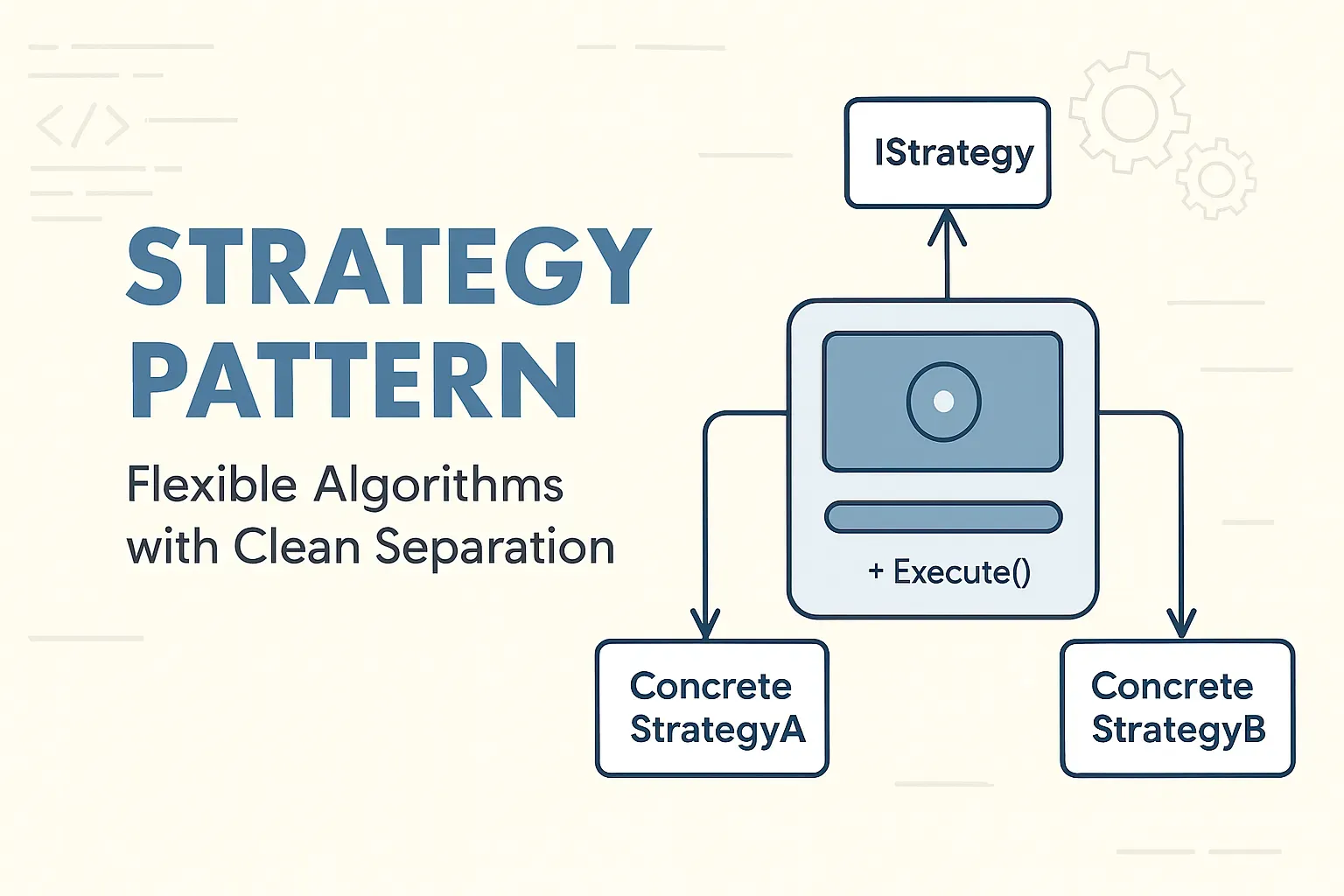
                      Context → delegates to a Strategy interface, implemented by ConcreteStrategyA, ConcreteStrategyB

                      +----------------+        +---------------------+
                      |    Context     |<>----->|      IStrategy      |
                      |----------------|        |---------------------|
                      | - strategy     |        | + Execute()         |
                      |----------------|        +---------------------+
                      | + SetStrategy()|
                      | + Execute()    |
                      +----------------+
                               |
                               ↓
                      +------------------+     +------------------+
                      |ConcreteStrategyA |     |ConcreteStrategyB |
                      +------------------+     +------------------+
Code Example: Payment Strategy
                      // Strategy Interface
                      public interface IPaymentStrategy
                      {
                          void Pay(decimal amount);
                      }

                      // Concrete Strategy A
                      public class CreditCardPayment : IPaymentStrategy
                      {
                          public void Pay(decimal amount)
                          {
                              Console.WriteLine($"Paid {amount:C} using Credit Card.");
                          }
                      }

                      // Concrete Strategy B
                      public class PayPalPayment : IPaymentStrategy
                      {
                          public void Pay(decimal amount)
                          {
                              Console.WriteLine($"Paid {amount:C} using PayPal.");
                          }
                      }

                      // Context
                      public class PaymentProcessor
                      {
                          private IPaymentStrategy _paymentStrategy;

                          public void SetStrategy(IPaymentStrategy strategy)
                          {
                              _paymentStrategy = strategy;
                          }

                          public void ProcessPayment(decimal amount)
                          {
                              _paymentStrategy.Pay(amount);
                          }
                      }

                      // Client
                      public class Program
                      {
                          public static void Main()
                          {
                              var processor = new PaymentProcessor();

                              processor.SetStrategy(new CreditCardPayment());
                              processor.ProcessPayment(150.00m);

                              processor.SetStrategy(new PayPalPayment());
                              processor.ProcessPayment(200.00m);
                          }
                      }
                      from abc import ABC, abstractmethod

                      class PaymentStrategy(ABC):
                          @abstractmethod
                          def pay(self, amount):
                              pass

                      class CreditCardPayment(PaymentStrategy):
                          def pay(self, amount):
                              print(f"Paid ${amount:.2f} using Credit Card.")

                      class PayPalPayment(PaymentStrategy):
                          def pay(self, amount):
                              print(f"Paid ${amount:.2f} using PayPal.")

                      class PaymentProcessor:
                          def __init__(self, strategy: PaymentStrategy):
                              self._strategy = strategy

                          def set_strategy(self, strategy: PaymentStrategy):
                              self._strategy = strategy

                          def process_payment(self, amount):
                              self._strategy.pay(amount)

                      if __name__ == "__main__":
                          processor = PaymentProcessor(CreditCardPayment())
                          processor.process_payment(150.00)

                          processor.set_strategy(PayPalPayment())
                          processor.process_payment(200.00)
Code Example: Sorting Strategy
                      public interface ISortStrategy
                      {
                          void Sort(List list);
                      }

                      public class BubbleSort : ISortStrategy
                      {
                          public void Sort(List list)
                          {
                              for (int i = 0; i < list.Count - 1; i++)
                              {
                                  for (int j = 0; j < list.Count - i - 1; j++)
                                  {
                                      if (list[j] > list[j + 1])
                                      {
                                          int temp = list[j];
                                          list[j] = list[j + 1];
                                          list[j + 1] = temp;
                                      }
                                  }
                              }
                              Console.WriteLine("Sorted using Bubble Sort: " + string.Join(", ", list));
                          }
                      }

                      public class QuickSort : ISortStrategy
                      {
                          public void Sort(List list)
                          {
                              list.Sort(); // Using built-in QuickSort
                              Console.WriteLine("Sorted using Quick Sort: " + string.Join(", ", list));
                          }
                      }

                      public class SortContext
                      {
                          private ISortStrategy _sortStrategy;

                          public void SetStrategy(ISortStrategy strategy)
                          {
                              _sortStrategy = strategy;
                          }

                          public void Sort(List list)
                          {
                              _sortStrategy.Sort(list);
                          }
                      }

                      public class SortExample
                      {
                          public static void Main()
                          {
                              var numbers = new List { 5, 3, 8, 4, 2 };
                              var context = new SortContext();

                              context.SetStrategy(new BubbleSort());
                              context.Sort(new List(numbers));

                              context.SetStrategy(new QuickSort());
                              context.Sort(new List(numbers));
                          }
                      }
                      from abc import ABC, abstractmethod

                      class SortStrategy(ABC):
                          @abstractmethod
                          def sort(self, data):
                              pass

                      class BubbleSort(SortStrategy):
                          def sort(self, data):
                              arr = data.copy()
                              for i in range(len(arr)):
                                  for j in range(0, len(arr) - i - 1):
                                      if arr[j] > arr[j + 1]:
                                          arr[j], arr[j + 1] = arr[j + 1], arr[j]
                              print("Sorted using Bubble Sort:", arr)

                      class QuickSort(SortStrategy):
                          def sort(self, data):
                              arr = sorted(data)
                              print("Sorted using Quick Sort:", arr)

                      class SortContext:
                          def __init__(self, strategy: SortStrategy):
                              self._strategy = strategy

                          def set_strategy(self, strategy: SortStrategy):
                              self._strategy = strategy

                          def sort(self, data):
                              self._strategy.sort(data)

                      if __name__ == "__main__":
                          numbers = [5, 3, 8, 4, 2]
                          context = SortContext(BubbleSort())
                          context.sort(numbers)

                          context.set_strategy(QuickSort())
                          context.sort(numbers)
More Real-World Examples
1. Compression Algorithm
You can use different strategies for compressing files such as ZIP, RAR, or GZIP.
2. Sorting
Context sets sorting strategy: QuickSort, MergeSort, or BubbleSort, depending on performance needs.
3. Authentication Strategy
Login context supports multiple strategies: LDAP, OAuth, SAML, or custom DB auth.
4. Logging Strategy
Log output can be directed to console, file, or cloud service via interchangeable strategies.
When to Use
- Multiple interchangeable algorithms
- Eliminating conditionals for algorithm selection
- Open/Closed Principle compliance
Pros and Cons
| Pros | Cons |
|---|---|
| Easy to switch strategies | Increased number of classes |
| Adheres to SOLID | Client must understand differences |
Real-World Use Cases
- Payment gateways
- Compression algorithms
- Input validation
- Sorting algorithms
- Authentication methods
- Logging destinations
Summary
The Strategy Pattern offers a powerful way to delegate and encapsulate behavior, making your code more flexible, extensible, and maintainable.
Comments
Loading comments…